
How Do Betting Odds Work?

In today’s article I will explain how bookmakers determine the odds, what their margin is, how to calculate probability from betting odds and vice versa, and how to work out your potential return.
I’ll also cover decimal, fractional and American odds, why prices move and how to compare the bookmaker’s price with your own estimate.
How the Odds Work
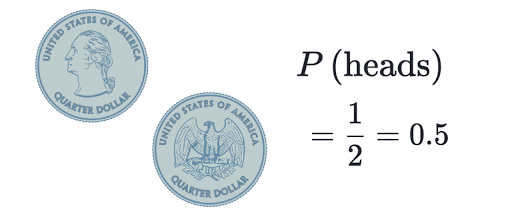
Betting odds show two things: the implied probability of an outcome and the potential return if your bet wins. European bookmakers mainly use decimal odds, while fractional odds are still common in the UK.
A simple way to understand probability is with a fair coin toss. There are two possible outcomes – Heads and Tails – and each has a probability of 0.5, or 50%.
To convert decimal odds into implied probability:
100 / decimal odds = implied probability (%)
Odds of 2.00 therefore imply a 50% probability. Conversely, if you believe an outcome has a 50% chance, its fair decimal odds are 2.00.
How to Read Betting Odds
The same probability can be displayed in several formats:
| Decimal | Fractional | American | Implied probability |
|---|---|---|---|
| 1.50 | 1/2 | -200 | 66.7% |
| 2.00 | 1/1 | +100 | 50% |
| 3.00 | 2/1 | +200 | 33.3% |
| 5.00 | 4/1 | +400 | 20% |
- Decimal odds include your returned stake. A £20 bet at 2.50 returns £50 in total, of which £30 is profit.
- Fractional odds show the potential profit relative to the stake. At 2/1, every £1 staked can produce £2 profit, plus the £1 stake back.
- American odds use positive and negative numbers. +200 means a 100-unit stake can produce 200 units of profit, while -200 means you need to stake 200 units to make 100 units of profit.
How to Calculate the Bookmaker’s Margin

This is where betting odds become more interesting. Bookmakers normally build a margin into their prices, which means the implied probabilities across all outcomes in a market add up to more than 100%. This difference is commonly called the overround or bookmaker’s margin.
For example, imagine a football 1X2 market with the following odds:
- Home: 2.00 = 50%
- Draw: 3.40 = 29.41%
- Away: 3.80 = 26.32%
Add the three implied probabilities together and you get 105.73%. The extra 5.73 percentage points represent the overround built into the market. This is also the method described in Smarkets’ explanation of betting margins, where the margin is calculated from the combined implied probabilities of all available outcomes.
To estimate the probabilities without the bookmaker’s margin, we need to adjust each outcome relative to the total market percentage. In this example, the Home selection accounts for 50% out of the full 105.73%, giving a no-margin probability of around 47.3%. That corresponds to fair decimal odds of approximately 2.11.
This distinction is useful when comparing the bookmaker’s price with your own estimate. The displayed odds show the price available in the market, while the adjusted probability gives a better idea of what that outcome would look like without the built-in margin.
What Odds Should You Bet On?

There is no single “good” betting odd. The important question is whether the available price is higher than the probability you assign to the outcome.
Suppose a bookmaker offers 2.30 on a team. That represents an implied probability of about 43.5%. If your analysis suggests the team has a genuine 50% chance, your fair price would be 2.00. In that case, 2.30 may represent value.
This is why our football tipsters do not judge a bet only by which team is more likely to win. Price matters as much as the prediction itself.
Before forming your own estimate, you can use our football statistics to study form, goals and other relevant data. You can also compare the idea with our football betting tips, Premier League predictions or Champions League predictions to see how different markets are analysed.
Why Do Betting Odds Change?
Odds are not fixed. They can move because of injuries, team news, weather, confirmed line-ups, betting activity or new information that changes expectations.
A shortening price means the odds have moved lower, while drifting odds move higher. Market movement can be useful information, but it does not automatically prove that an earlier bet was right or wrong.
If you consistently take a better price than the closing market, that can be a useful indicator of the quality of your selections. It is still not a guarantee of profit.
How to Calculate Your Payout and Profit
Most of you probably know how to calculate a return, but the formula is simple:
Payout = stake × decimal odds
Profit = payout – stake
A £20 bet at 2.50 therefore gives a £50 total return and £30 net profit.
Betting Calculators
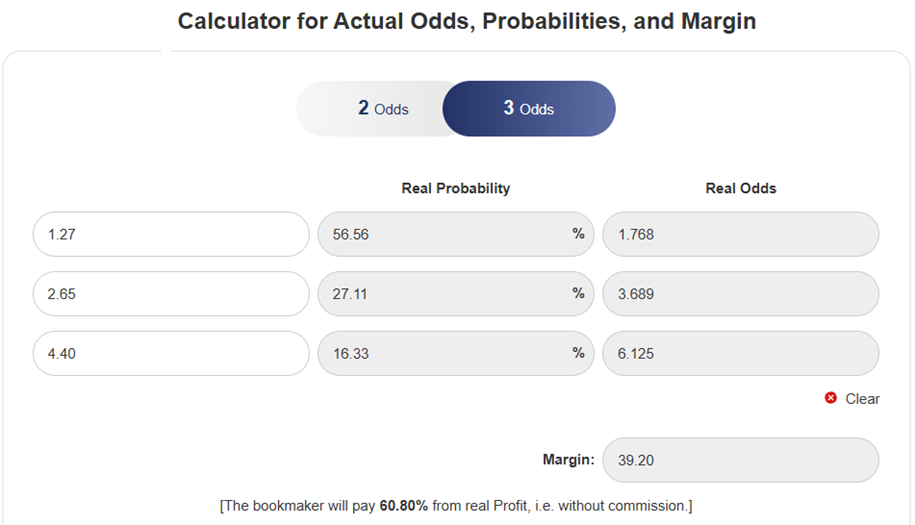
Once you start comparing several bookmakers or multiple markets, doing these calculations manually becomes slow and easy to get wrong. A calculator is especially useful when you want to quickly check implied probability, bookmaker margin or whether two different prices represent a meaningful difference.
Fortunately, instead of doing all these calculations yourself, we have created betting calculators that make the process easier. They can help you convert odds and probabilities and examine bookmaker margins when you want to compare several markets quickly.
Do Some Bookmakers Offer Better Odds?
Yes. Margins vary between bookmakers, sports and individual markets. One operator may offer a strong price on Premier League matches but be less competitive on another sport or a smaller market.
For that reason, it is usually more useful to compare the actual price available for the bet you want than to assume one bookmaker always has the lowest margin.
Conclusion
Understanding how betting odds work is one of the basic skills behind sensible betting decisions. Odds tell you the market’s implied probability and your potential return, while the bookmaker’s margin explains why the percentages across a market usually add up to more than 100%.
The next step is learning to compare those market prices with your own probability estimates rather than simply trying to predict the winner.
If we missed something, add it in the comments