
What is the Best Premier League Betting Strategy (from PRO Gambler)

I’ve been making a living from betting for 11 years now, and I’m profitable across Europe’s five biggest football leagues. So in this article, I’m going to show you how I analyse matches, where bookmakers make mistakes, and how I exploit those mistakes to finish almost every month in profit.
My approach isn’t based on looking for the same type of bet throughout the entire season. One of the most important things to understand is that the circumstances keep changing, and the way you analyse a match has to change with them.
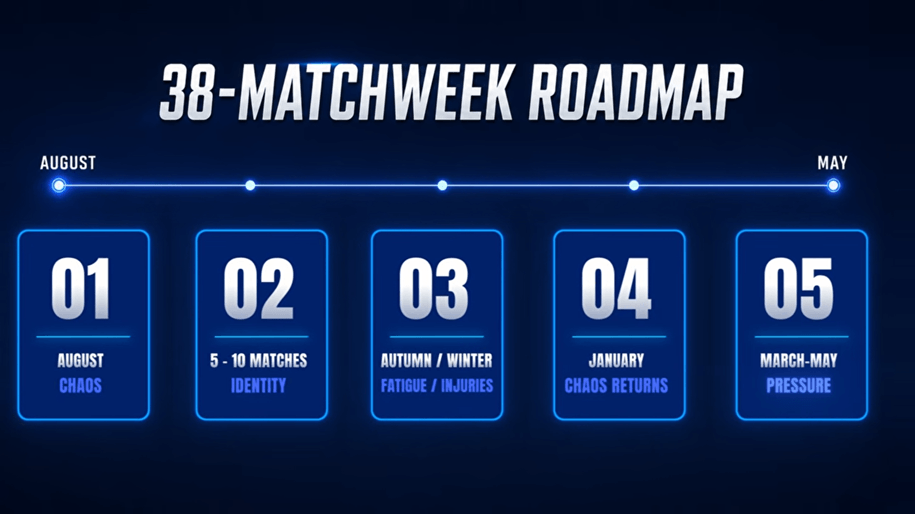
And the first big mistake is analysing all 38 matchweeks in the same way. Because a match in August has almost nothing in common with a match in December. In August, you have transfers, new managers, new players and almost no meaningful information from competitive matches.
By December, you have accumulated fatigue, injuries, squad rotation and teams playing three matches in eight days. And by April, you have the pressure of the title race, European qualification or the battle for survival. That’s why I look at the season as a series of separate blocks, usually around five to seven matches at a time.
The goal isn’t to use one system across all 38 matchweeks. The goal is to understand exactly what type of edge you’re looking for at that particular stage of the season. This is also one of the key principles I follow in my advice on successful betting – the strategy must adapt to the situation, not the other way round. Before analysing a specific match, first ask yourself: “What is the main problem teams are dealing with at this stage of the season?”
Because in August the answer might be uncertainty, while in December it might be fatigue. And that changes the bet itself. Starting with the context of the season rather than simply looking at the teams and the odds makes it much easier to understand which factors actually matter at that particular moment.
The Start of the Season
The first block is the start of the season. And the key word here is chaos. The transfer window is still open. One player doesn’t know whether he’ll stay, another arrived 10 days ago, while a third knows the club is looking to sign someone in his exact position. And most importantly, teams are coming into the season with virtually no competitive football behind them for the past few months.
Pre-season friendlies can’t replicate the pressure of the Premier League. You might have won five out of six friendlies, but that doesn’t tell you how the team will react if they concede in the 12th minute in front of 50,000 people. That’s why in August I’m not necessarily looking for the strongest team. I’m looking for the team with the fewest unknowns.
Why an Established Manager Matters
And this is where one very interesting factor comes in – how long the manager has been at the club. In my analysis of the last five seasons, managers who had completed three or more pre-seasons with their club performed much better against the Asian Handicap in the opening matchweek than brand-new managers. The difference between the newest and most established categories is more than 70%.
That doesn’t mean you should blindly back every established manager. Imagine two teams. The first has a new manager, a new centre-back, a new midfielder and is switching its system from 4-2-3-1 to 3-4-2-1. The second is playing with almost the same squad and the same manager for the third consecutive year. On paper, the first team might have more expensive players. But there’s far more certainty with the second team.
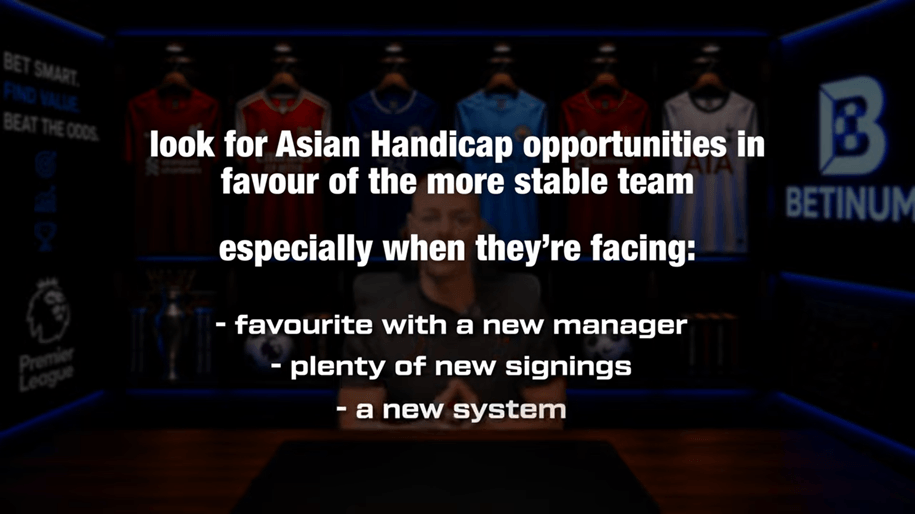
To sum up – in the opening two or three matchweeks, look for Asian Handicap opportunities in favour of the more stable team, especially when they’re facing a favourite with a new manager, plenty of new signings or a new system. Don’t automatically bet on the bigger name. Bet on stability.
Look for Identity After 5-10 Matches
After around five to ten matches, the focus changes. The transfer window is closed, the squads are settled and managers have real competitive feedback to work with. And now we can start to understand which teams are actually good. For me, the key word here is identity.
Look for Repeatability, Not Just Results
Does the team play in the same recognisable way? Does it consistently create the same types of chances? Can it do that against different opponents? This is particularly important in the Premier League, where the variety of playing styles and the fast pace are among the league’s key characteristics.
For example, a team wins three matches in a row. If you only look at the results, you say: “They’re in form.” But then you see that one win came after the opposition had a player sent off, another came from a 90th-minute penalty, and the third was against the weakest team in the league. That isn’t the same as a team that has faced three different styles, consistently created chances and controlled matches.
Look for repeatability. Not short-term results.
Watch the First Win, Defeat and Crisis
This is especially important with newly promoted teams, because a few early results can completely change the confidence around the club.
If a Premier League newcomer takes seven points from their first three matches, the entire psychology around the team can change. The players start believing they belong at this level. The supporters do too. And the opposite is also true – three early defeats can create enormous pressure.
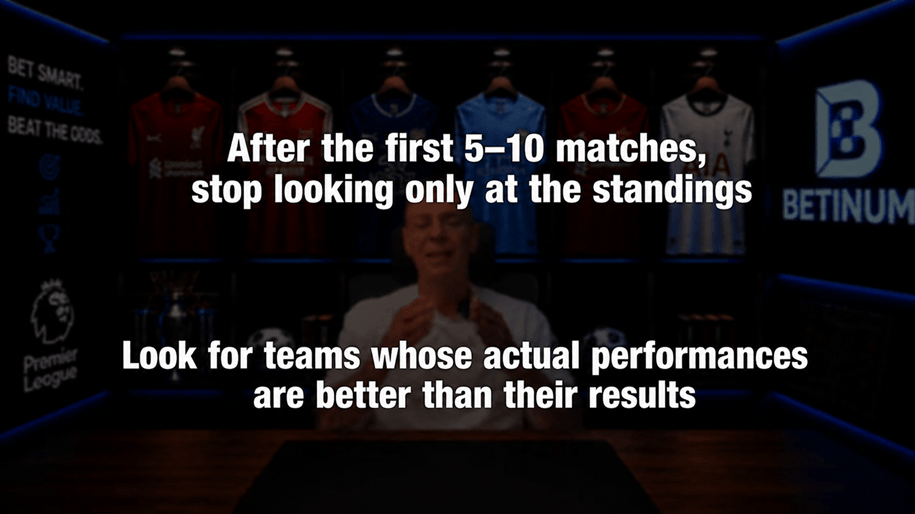
To sum up – after the first five to ten matches, stop looking only at the league table. Look for teams whose actual performances are better than their results suggest. If the market has punished them for two or three defeats, but their form remains consistent, that’s exactly where a value bet might present itself.
And often, instead of backing them to win outright, it makes more sense to look at the Asian Handicap – for example, moving from -0.5 to +0.5.
Autumn and Winter
Then we move into autumn and winter. And once again, the analysis changes. After 90 days of competitive football, fatigue and injuries start to appear, pitches change and the fixture schedule becomes more demanding.
And now you shouldn’t just be asking: “How strong is the starting XI?” Ask: “How good are players number 12, 13, 14 and 15?” Because in September, you might be able to play almost every match with your strongest XI. By December, that becomes much more difficult. The same principle also applies to championship betting, where the heavier schedule makes rest, rotation and squad depth even more important.
Squad Depth Becomes Crucial
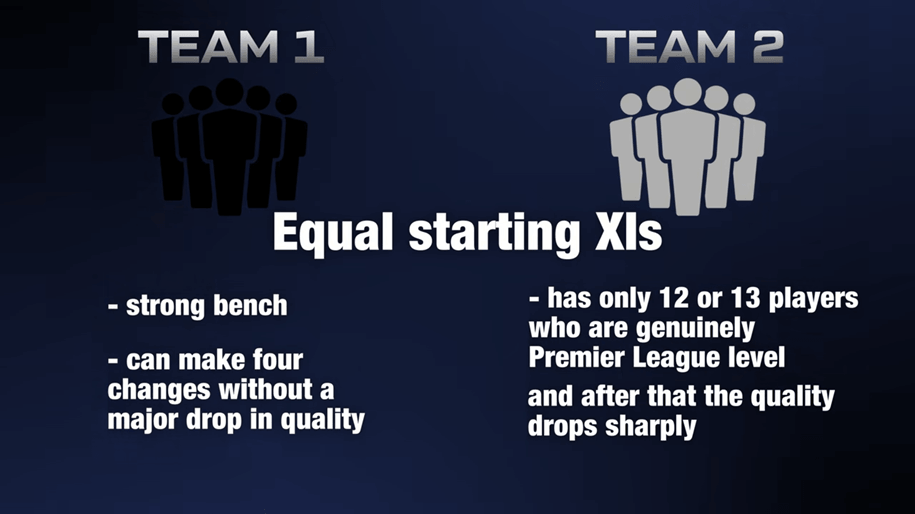
Imagine two teams with roughly equal starting XIs. One has a strong bench and can make four changes without a major drop in quality. The other has only 12 or 13 players who are genuinely Premier League level, and after that the quality drops sharply.
After a Saturday – Wednesday – Saturday run, that becomes a huge difference. This is especially relevant in championship football betting, where teams often have to manage a long and demanding season with limited squad depth.
Pressing Changes as Fatigue Builds
The same press that looked devastating in September might start arriving half a second late in December. And half a second in the Premier League is a massive difference.
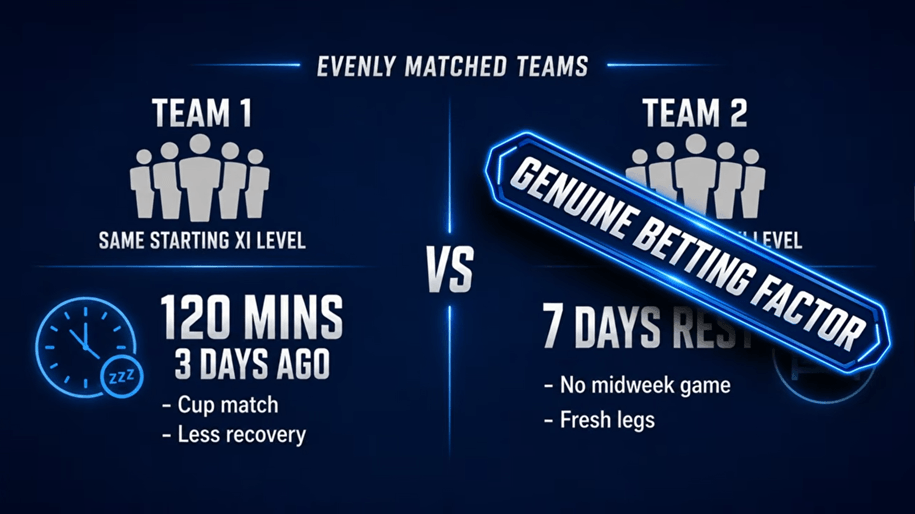
To sum up – during a congested winter schedule, look first at rest, rotation and squad depth. If you have two evenly matched teams, but one played 120 minutes in a cup match three days ago while the other has had a full week to recover, that is a genuine betting factor.
Don’t just look at form. Look at the accumulation of minutes.
Stability During the Winter
There’s something else that becomes important around winter. The more matches there are, the less time managers have to devise a complicated new game plan for every opponent. So it becomes increasingly important to understand what a team can do on autopilot.
Which teams have such a clear identity that even when they’re not playing well, they still stay in the match? These are the teams that sometimes find a way to win ugly. And this is where we need to be careful with xG.
Be Careful with xG
Yes, data is important, and it is precisely on this that many mathematical predictions are based. But if a team consistently grinds out draws and wins during difficult periods, you need to ask whether that’s simply luck or the result of a strong collective structure.
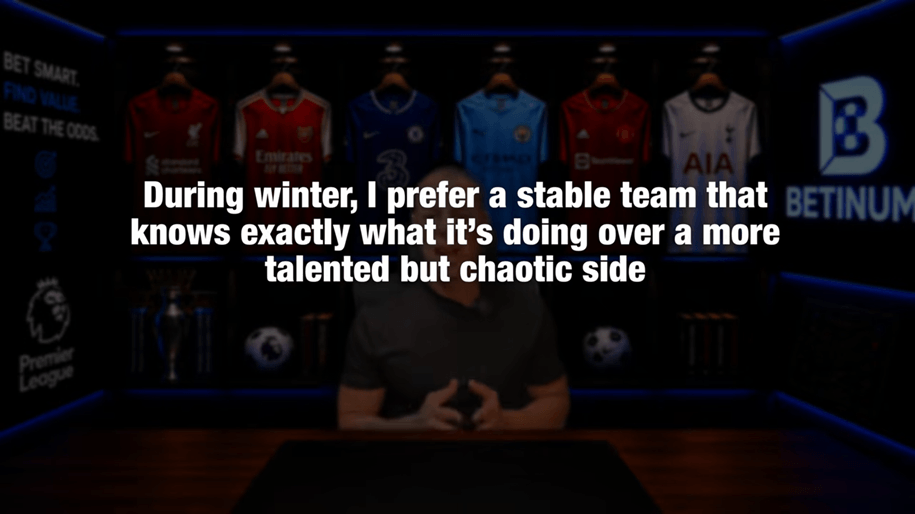
To sum up – during winter, I prefer a stable team that knows exactly what it’s doing over a more talented but chaotic side. Especially on Asian Handicap lines around 0 or +0.25.
January Brings Back Uncertainty
Then January arrives. And the chaos returns. The transfer window opens again, bringing back many of the same unknowns we saw at the start of the season.
A player who was completely focused in December might now be thinking about a transfer. Another knows the club is looking for his replacement. A third wants to leave. Add injuries, postponed fixtures and different recovery periods into the equation and the picture becomes even more complicated. In championship betting, January can be even more unpredictable because transfer activity, injuries and fixture congestion often overlap.
One team might get 10 days without a match. Another might get only three. On paper, their strength hasn’t changed. But the circumstances have.
To sum up – in January, reduce how much you trust pure team-strength ratings. Check who is involved in transfer speculation, who is injured, who has played a lot of minutes and who has had more time to recover.
If there are too many unknowns, sometimes the best bet is no bet at all.
The End of the Season
Then we reach the final stage of the season – March, April and May. By now, everyone is looking at the table, and the questions change. Who still has enough left in the tank for the final sprint? Who peaked too early? Who can handle the psychological pressure?
A lot of bettors make one classic mistake: “This team has to win, so they will win.” No. Needing to win and being able to play freely are two completely different things.
Pressure Changes Behaviour
Imagine a team fighting for Champions League qualification that desperately needs three points against a mid-table opponent. If it’s still 0-0 in the 70th minute, who feels more pressure? The favourite. The other team can sit back, wait and counter-attack.
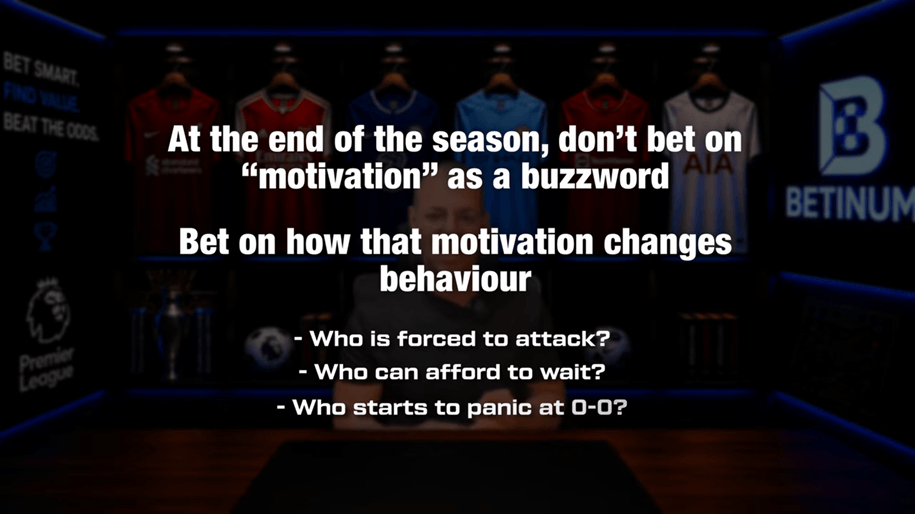
To sum up – at the end of the season, don’t bet on “motivation” as a buzzword. Bet on how that motivation changes behaviour. Who is forced to attack? Who can afford to wait? Who starts to panic at 0-0?
How to Turn the Analysis Into a Bet

And that brings us to the most important part – how do we turn all of this into an actual bet? I would start with the Asian Handicap. The reason is simple. With the 1X2 market, you have a win, draw or defeat. With the Asian Handicap, it’s much easier to test whether a certain type of team consistently performs better than the market expects.
Start with the Asian Handicap
For example, you believe that a certain type of underdog is being undervalued. Don’t immediately start by backing them to win outright at 4.00. First, check whether these teams consistently cover +0.5 or +0.25 on the Asian Handicap. If they do, you now have evidence that the market might be undervaluing them.
Then you can decide whether you want the more conservative handicap or the more aggressive outright win. That’s exactly the difference between a feeling and a strategy.
To sum up – prove the idea on the Asian Handicap first. Then, if the signal is strong enough, look for the higher return from backing the underdog outright. Not the other way round.
The Edge Beyond the Numbers

And the final thing I want you to remember is this: don’t try to beat the biggest betting syndicates at their own game. They have enormous databases covering players, xG, ratings and every kind of model imaginable. It’s better to let them establish the baseline strength of each team. You can also check some of these statistics in our football stats section before forming your own opinion on the match.
Your job is to look for the things that are difficult to fit neatly into a spreadsheet – a new system, an unsettled player, a tired squad, a tight-knit team, too much pressure, a strong response to a crisis, a manager who knows his team inside out, or a favourite that the market has overrated. The same applies to championship football betting – the numbers matter, but context such as fatigue, squad stability and motivation can still create opportunities.
These factors provide context that pure numbers cannot always capture. The data can tell you how strong a team is in general, but it cannot always show you how well prepared that team is for this particular match at this particular stage of the season.
Five Questions Before Every Bet
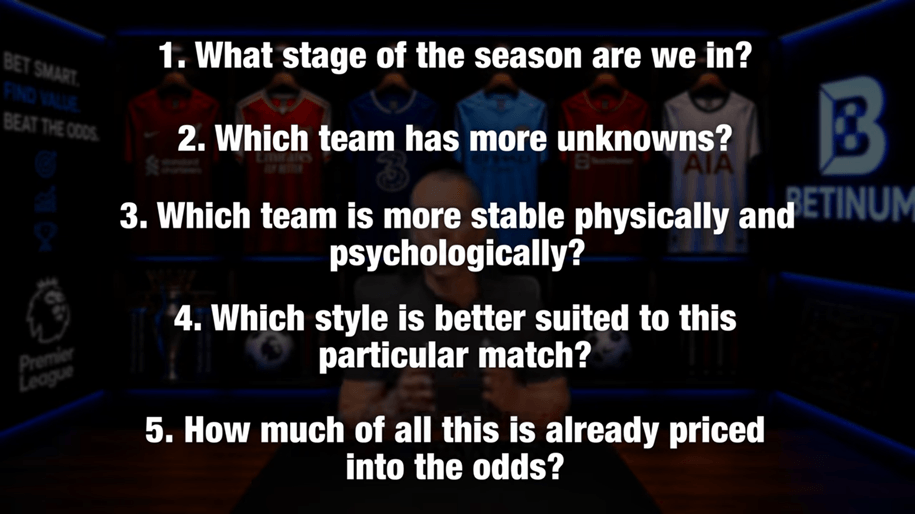
So before every bet, ask yourself five questions:
- What stage of the season are we in?
- Which team has more unknowns?
- Which team is more stable physically and psychologically?
- Which style is better suited to this particular match?
- How much of all this is already priced into the odds?
If you’re not sure how the market translates probability into price, first take a look at how odds work. Because the goal isn’t simply to predict the winner, but to find a situation where the market has priced the match incorrectly.
And once you start thinking this way, you’re no longer simply betting on Manchester United, Arsenal or any other team. You’re betting on the situation. And that’s where the real edge begins.
Quick Betting Plan
To make everything above easier to apply in practice, here is a short checklist for the different stages of the season.
Start of the Season
- Opening matchweek + new manager – favour the team with the more established manager. Check the Asian Handicap first.
- August + lots of new players – be careful with short-priced favourites. A strong squad still needs time to gel.
After the First 5-10 Matches
- After 5-10 matches – if a team is consistently playing well, you can start trusting it more. Look at the performances, not just the results.
- Strong team + poor results – don’t write them off immediately. If the performances remain good and the odds have drifted, there may be value.
- Underdog playing well – check +0.25 or +0.5 on the Asian Handicap instead of backing them to win outright.
- Strong counter-attacking team – they can sometimes be a better bet as the underdog when the opposition is expected to control possession.
Autumn and Winter
- Congested winter schedule – look at rest and squad depth. The fresher team may have an advantage.
- High-pressing team + tired players – be careful with short odds during the winter. The intensity may drop.
January
- January – be careful with teams whose key players are involved in transfer speculation. The uncertainty can affect performances.
End of the Season
- End of the season + “must-win” situation – don’t bet simply because a team has to win. Always check whether the odds still offer value.
The Simplest Rule
Before placing a bet, ask yourself:
- What stage of the season are we in?
- Which team is more stable?
- Which team is fresher?
- Which style is better suited to this match?
- Have the odds already accounted for all of this?
Then choose the market based on the situation rather than simply backing the team with the bigger name.
| Situation | Market to Consider |
|---|---|
| Strong favourite + genuine advantage | Favourite / negative AH |
| Undervalued underdog | +0.25 / +0.5 AH |
| Evenly matched teams | AH instead of an outright win |
| You simply "feel" one team is better | No bet |
Final Thoughts
The main idea is simple: don’t bet on names. Bet when the situation + the odds give you an edge.
At different stages of the season, you’ll be looking for different signals. Sometimes that will be an established manager, sometimes a fresher squad, a more suitable style or a favourite dealing with too much pressure. The important thing is not to assume that the stronger team automatically represents the better bet.
The goal always stays the same – find the moment when the market hasn’t priced the situation correctly. If you’d like to see how we put this approach into practice, take a look at our daily predictions or, specifically, those for the Premier League. And if you’d prefer to receive ready-made analyses and picks, have a look and subscribe to one of our plans.
If we missed something, add it in the comments