
What Is a Betting Edge and How Can You Find Yours?

Two people are analysing the same football match. The first is convinced the home team will win because they’ve won their last four games. The second estimates their chances of winning at 55% and checks the odds offered by the bookmaker.
Both could predict the correct result. But who has better reasons for placing the bet, and how can we tell whether their assessment is actually accurate?
Over the years, I’ve learned that finding a sports betting edge takes much more than good football knowledge. You need to understand where your advantage comes from, how much it’s worth and whether you can back it up with real data.
What Is a Betting Edge in Sports Betting?
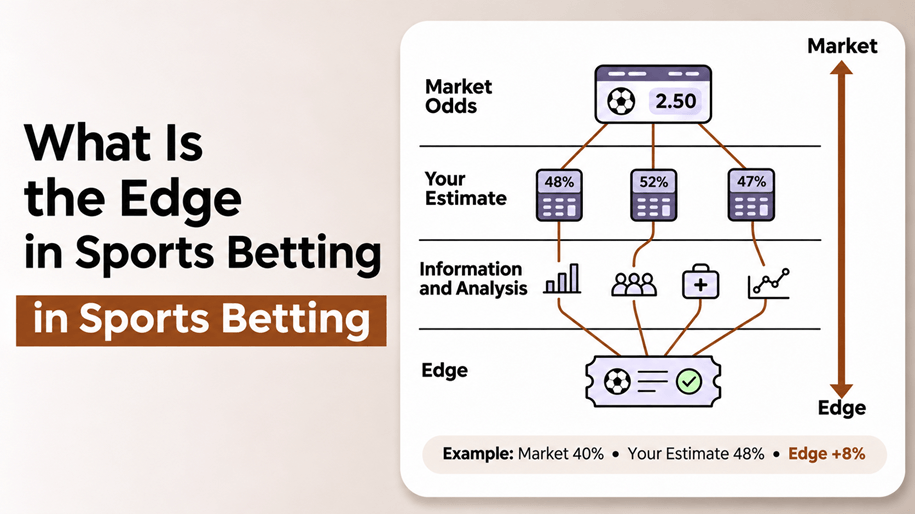
A betting edge is the advantage you have when you estimate an outcome’s probability to be higher than the minimum probability needed to break even at the available odds.
For example, odds of 2.00 mean you need at least a 50% win rate to break even over the long term. If the actual probability of winning is 55%, you have a potential edge.
Of course, bookmakers build their own margin into the odds. That’s why you need to understand how betting odds work and what price you’re actually getting when evaluating a bet.
The hardest part is estimating the probability accurately enough. If you believe an outcome has a 55% chance of happening when the actual probability is only 45%, your calculated edge exists only in your analysis.
How to Calculate Your Betting Edge
Let’s assume you estimate a team’s probability of winning at 52%. Different odds will give you different expected returns.
| Odds | Min. chance to break even |
Expected edge |
|---|---|---|
| 1.85 | 54.05% | -3.8% |
| 1.95 | 51.28% | +1.4% |
| 2.05 | 48.78% | +6.6% |
We can calculate this using a simple formula:
Estimated edge (%) = (Your estimated probability × Decimal odds – 1) × 100
The probability must be expressed as a decimal. For example, 52% becomes 0.52. At odds of 2.05, the calculation is (0.52 × 2.05 – 1) × 100 = 6.6%.
This means that across a large number of similar bets, assuming our probability estimate is accurate, we’d expect an average profit of £6.60 for every £100 staked. For a more detailed explanation, take a look at our guide to expected value in sports betting.
Where Does a Real Sports Betting Edge Come From?
A betting edge can come from several sources, but the best opportunities often appear when you have deeper knowledge, better data or information that the market hasn’t fully accounted for. Here are three ways you might identify them.
Specialised Knowledge of a Particular Market
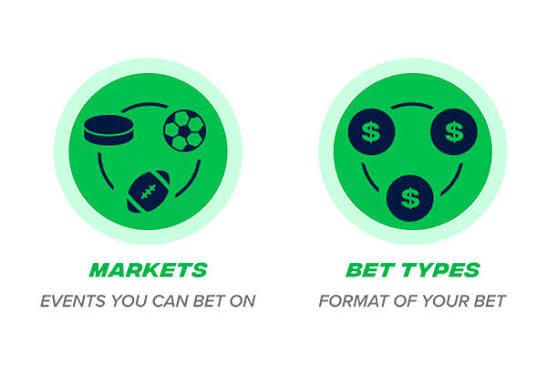
If you regularly follow a particular league, you’ll gradually develop a better understanding of its teams, managers and players.
For example, you might notice that a particular team creates significantly fewer chances without a certain midfielder. If the market hasn’t fully accounted for his absence, there could be an interesting opportunity.
Making Better Use of Football Statistics
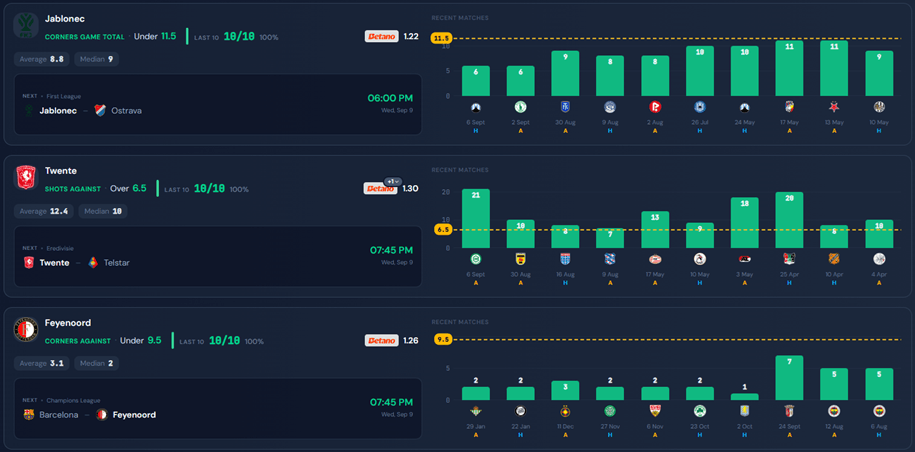
Imagine two teams that have both won four of their last five matches. One consistently creates high-quality scoring chances, while the other often wins despite taking very few shots, thanks to excellent goalkeeping performances.
This is where indicators such as xG, chances conceded and the quality of opposition can help you make a more accurate assessment. That’s why I use football statistics to check whether my impressions of a team are supported by the numbers.
Identifying Mispriced Odds
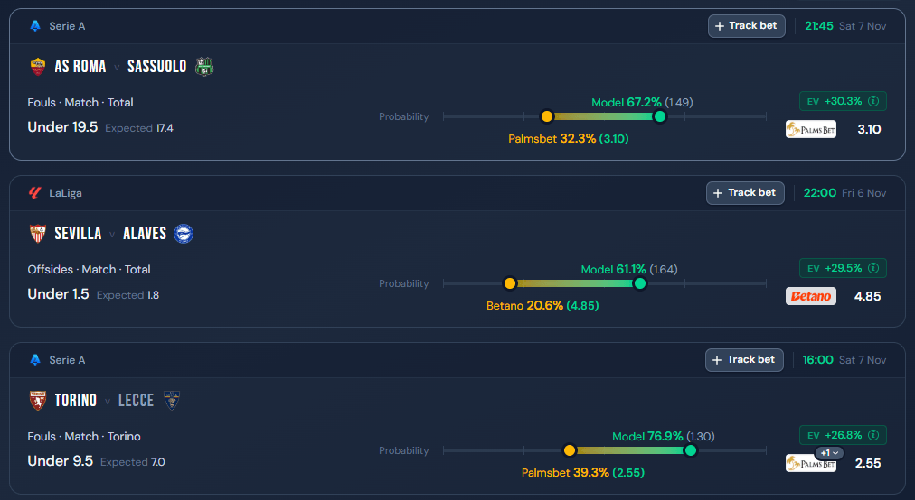
Sometimes new information hasn’t yet been fully reflected in the odds. In other situations, your analysis might suggest a different probability from the one implied by the market. You need solid reasons for that difference. Disagreeing with a bookmaker doesn’t automatically mean you’ve found an edge.
How to Find Your Own Betting Edge
I’d start with five relatively straightforward steps:
- Choose a specific market. For example, goals, cards or corners in a league you follow regularly.
- Identify the important indicators. Use statistics and information that could influence your chosen outcome.
- Estimate the probability. Make your own assessment before allowing the bookmaker’s odds to influence your judgement.
- Compare the available odds. Check whether any bookmaker offers a price that’s high enough compared with your estimate.
- Record and review your bets. Keep track of your original probability estimates, odds and results.
A good starting point is to test your idea against the available data. We’ve already covered how to use historical data before building a betting strategy in detail.
The Edge You Find vs the Edge You Actually Get

There’s one detail here that can cost money even when your analysis is good. Imagine you estimate an outcome’s probability at 52% and find odds of 2.10. That gives you an estimated edge of 9.2%.
However, by the time you open your bookmaker account, the odds have dropped to 1.90. If your probability estimate remains at 52%, your expected return is now -1.2%.
Same selection, completely different betting conditions.
With a 52% estimated probability, the break-even odds are approximately 1.923. Anything below that price would make the bet unprofitable according to your assessment.
That’s why I’d decide on the lowest odds I’m willing to accept before placing a bet. Remember that bookmakers also impose limits – sometimes an attractive price is only available for a small stake.
Timing matters too. In our article on early vs late betting, we explain how odds and market liquidity change before kick-off.
How Do You Know If You Really Have a Betting Edge?
A winning streak can look convincing, especially when you’ve correctly predicted seven or eight bets in a row. But with so few observations, luck can have an enormous influence.
That’s why I’d track several indicators together.
| Metric | What it shows | Limitation |
|---|---|---|
| Win rate | How often you win | Does not account for the odds |
| Profit and loss | Your actual financial result | Can be influenced by variance |
| Closing Line Value (CLV) | Whether you get a better price than the closing line | Depends on market quality |
| Probability accuracy | How reliable your probability estimates are | Requires enough data |
The accuracy of your probability estimates deserves particular attention. If you regularly assign a 60% probability to certain outcomes, roughly six out of every ten similar predictions should be successful over a sufficiently large sample.
There’s scientific research supporting this approach. A 2024 study from the University of Bath compared different models for predicting basketball games and demonstrated the importance of well-calibrated probability estimates.
Another useful indicator is CLV. In an analysis by Joseph Buchdahl published by Pinnacle, he explores how consistently obtaining better odds than the closing market can help evaluate a bettor’s skill.
To make these comparisons, you need a consistent betting record. Our guide explains how to track your betting results properly.
How Can You Find an Edge in Sports Betting?
I’d start with a market I understand well and a specific idea I can test. Then I’d compare my own probability estimates with the available odds, without feeling the need to find a bet in every match.
The most important thing is having good reasons to trust your method and enough data to recognise when you’re getting things wrong.
Even good analysis doesn’t guarantee a profit. Sports betting always involves financial risk, so only use money you can afford to lose and set clear limits in advance.
If we missed something, add it in the comments