
Early vs Late Betting: When Is the Best Time to Place a Bet?

You find an attractive price on Wednesday for a Premier League match scheduled for Saturday. The odds are 2.20, but you’re not sure whether to place the bet immediately or wait. By Friday, the price has dropped to 1.95. You were right about the direction, but you’ve missed the better odds.
Of course, the opposite can happen too. You bet early, only to see the price improve later.
So, is it better to bet early or late? From my experience, the answer comes down to two things: how much value you can find in the odds and how much money the market allows you to place at that price.
What Is Early and Late Betting?
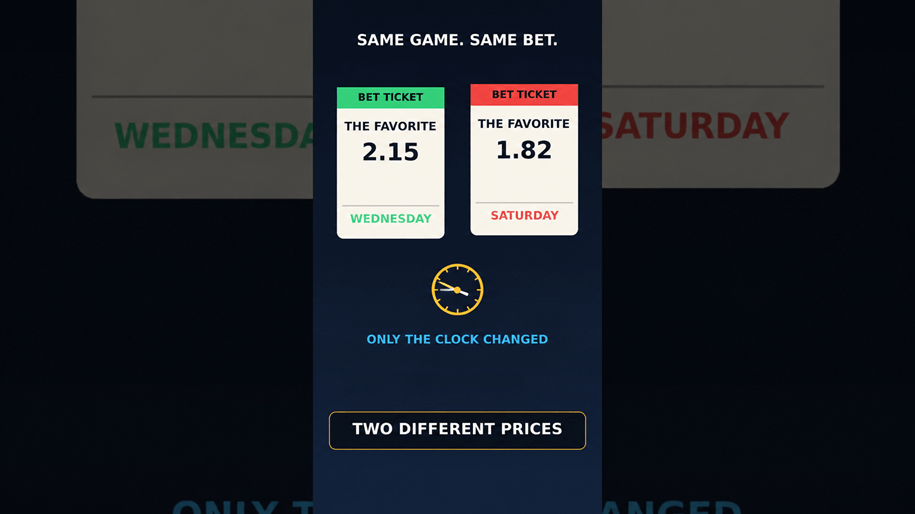
Early betting means placing a bet shortly after the bookmaker publishes its opening odds, often several days before the match. Late betting means waiting until closer to kick-off, sometimes just minutes before the game begins.
The biggest difference isn’t simply how much information is available. It’s also market liquidity – how much money can be bet without significantly affecting the price.
As a market develops, both the odds and the maximum permitted stakes can change considerably.
Early Betting: Pros and Cons

Advantages of Early Betting
The main advantage is that opening odds can contain more pricing errors. Bookmakers initially work with their own models and available information, but the market hasn’t yet had enough activity to correct every mistake.
This creates opportunities for people who have have done their research, including using football statistics before the market has corrected the initial inaccuracies. If you find odds of 2.30 that subsequently drop to 1.90, you’ve gotten a significantly better price than someone who placed the same bet right before the start of the match.
This is particularly interesting when you have reliable information that hasn’t yet been fully reflected in the market.
Disadvantages of Early Betting
The biggest drawback is lower liquidity and smaller betting limits.
Bookmakers know their opening prices may need adjusting, so they often restrict how much they’re willing to accept. As experienced bettors place their wagers, bookmakers use that activity to improve their odds and gradually increase the limits.
Former Pinnacle sales director Marco Blume described how limits on a Premier League match could rise from around £2,000 at opening to £50,000 shortly before kick-off. These were illustrative figures, but they show how dramatically the allowed stakes can change.
There’s also the risk of new information appearing after you’ve placed your bet. An unexpected injury or team selection can change the situation completely.
Late Betting: Pros and Cons

Advantages of Late Betting
The closer we get to kick-off, the more information becomes available. Confirmed line-ups, injuries and other developments have usually been reflected in the odds.
But for professional bettors, the bigger advantage is often higher liquidity. Bookmakers tend to accept larger stakes once the market has attracted enough activity and they’re more confident in their prices.
This distinction matters. If you’re part of large betting syndicates, there’s not much point in finding a 5% edge when you can only place a minimum bet. A smaller edge in a market that allows large bets can turn out to be much more useful.
You can read more about the differences between bookmakers in our guide to soft and sharp bookmakers.
Disadvantages of Late Betting
The downside is that many of the best early betting odds have already disappeared. Professional bettors have identified mistakes, bookmakers have adjusted their prices, and the market is generally harder to beat.
You may be able to place a larger bet, but finding an attractive price becomes more difficult. More liquidity doesn’t automatically mean better betting opportunities.
Early vs Late Betting: Key Differences
| Indicator | Early betting | Late betting |
|---|---|---|
| Odds errors | Potentially more opportunities | Usually fewer |
| Market liquidity | Usually lower | Usually higher |
| Bet limits | Often lower | Often higher |
| Available information | Less complete | More complete |
| Potential edge | May be greater | Often smaller |
| Main challenge | Limited bet size | Finding good odds |
The important thing is to understand what you’re trading off. Early betting may offer a better price, while late betting usually gives you more room to place a bet.
Why Professional Betting Syndicates Often Bet Late

A good example comes from Tony Bloom, the Brighton owner behind Starlizard, one of the best-known betting operations in the world.
Bloom’s syndicate operates on a completely different scale from ordinary bettors. Its models look for mispriced odds, but finding a good price isn’t enough. The team also needs markets capable of accepting large amounts of money.
A detailed Business Insider investigation into Starlizard describes how the syndicate places substantial bets through Asian markets, where liquidity can be high enough to handle large positions. Match days are particularly important for this activity.
For operations of this size, securing a modest advantage with substantial stakes can be more useful than discovering an excellent early price with a very small limit.
Is the Middle Ground the Best Time to Bet?
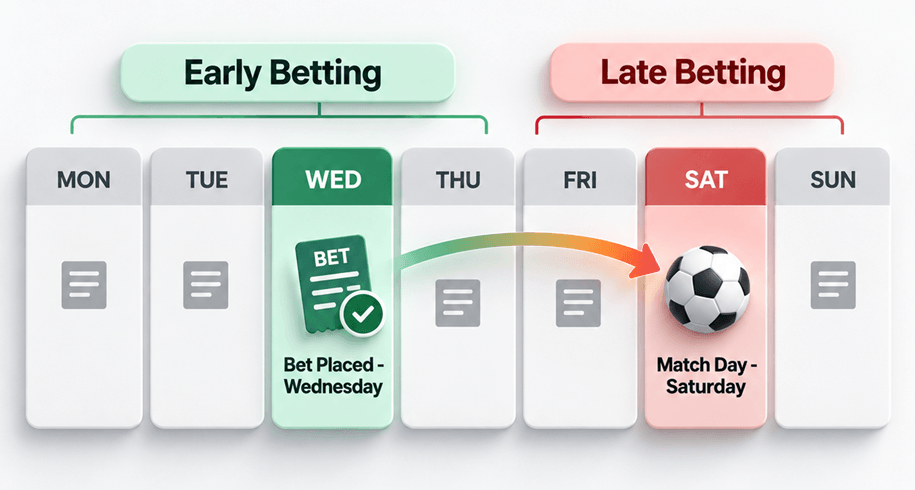
For many bettors, I think the most practical approach is somewhere between the opening odds and the final minutes before kick-off.
Personally, I would rather look for opportunities once the market has had some time to develop, but before every attractive price has been corrected.
For example, if a Premier League match takes place on Saturday and the opening odds appear on Wednesday, Thursday or Friday might be a reasonable time to look for a bet. The market may already offer better liquidity without being quite as settled as it will be immediately before kick-off.
This isn’t a rule that works for every match. If the price is clearly attractive on Wednesday, waiting may cost you that opportunity. And if important information is still missing on Friday, there may be a good reason to wait.
The aim is to find a balance between a worthwhile price and enough liquidity to place your bet. This difference also matters when choosing between our subscription plans – for some bets, the odds drop more quickly and require a timely response, while for others, the odds remain stable longer and the risk of low limits is lower.
Does the League Make a Difference?

Absolutely. Premier League markets attract considerable attention from bookmakers and professional bettors. Mistakes can be identified and corrected relatively quickly.
Smaller competitions are different. With fewer people analysing the matches and less betting activity, pricing errors may survive closer to kick-off. However, lower liquidity can remain a problem even at that stage.
An academic study published in the International Journal of Forecasting, covering 33,060 football matches across 11 European leagues, found that market efficiency varied between competitions. It also identified some pricing inefficiencies when comparing the best available odds across bookmakers.
The lesson is that no single betting schedule works equally well across every league.
How to Use Closing Line Value to Check Your Timing
One of the most useful ways to review your betting decisions is through Closing Line Value (CLV). The closing line is the final pre-match price, and CLV compares that price with the odds you originally took.
Imagine you placed a bet at 2.00 and the odds dropped to 1.80 before kick-off. You secured a better price than the closing market.
| Your odds | Closing odds | What it shows |
|---|---|---|
| 2.00 | 1.80 | Positive CLV - you got higher odds |
| 2.00 | 2.00 | No difference in the odds |
| 2.00 | 2.20 | Negative CLV - a better price was available later |
Positive CLV doesn’t guarantee that your bet will win or that you’re profitable. However, consistently securing better prices than a reliable closing market can be a useful sign that your timing and analysis are working.
I’d suggest recording both your original and closing odds. Our guide on tracking your betting results explains how to keep those records organised.
You can also use our betting odds calculators to understand the probabilities behind different prices.
So, Is It Better to Bet Early or Late?

Early betting gives you more opportunities to find prices that haven’t been properly adjusted, but often comes with smaller limits and less liquidity. Late betting offers more information and higher limits, although many pricing errors may already have disappeared.
My preference is to look for opportunities somewhere in the middle, when the market has developed enough to accept reasonable stakes but may still offer attractive odds.
That said, I wouldn’t ignore a good early price or automatically reject a late opportunity. The timing has to make sense for the particular match, market and odds available. The same applies when you’re looking at our football predictions for today, it’s not enough to simply like a particular pick; it’s also important what odds you’re able to get on it.
And if you want to know whether you’re consistently choosing the right moment, start comparing the odds you take with the closing prices. Over time, that comparison can tell you far more than whether your last few bets won or lost.
If we missed something, add it in the comments