
What Is Dutching in Betting and How Does It Work?

Imagine you’re expecting a closely contested football match and believe the most likely correct scores are 1-0, 1-1 and 2-1. Each result has different odds, and you have a total of £60 to stake. How should you split that money so you receive the same payout whichever of those three results wins?
That’s where Dutching comes in – a method of splitting your total stake across several selected outcomes. It allows you to cover more possibilities while knowing in advance how much you’ll receive if any of your selections wins.
Let’s look at how it works, how to calculate the individual stakes and when this approach might make sense.
What Is Dutching in Sports Betting?
Dutching is a betting strategy where you place separate bets on two or more possible outcomes of an event, splitting your money according to the odds of each selection. The usual aim is to achieve roughly the same payout whichever of your chosen outcomes wins.
The method is commonly used in markets with several possible results, such as correct score betting in football or picking the winner of a horse race.
There’s one important detail – you can choose to cover only some of the possible outcomes. If the event finishes differently, all your selections could lose.
Dutching increases the number of outcomes you cover, but that doesn’t automatically give your bets positive expected value.
How Does Dutching Work?
Let’s return to our football example. You’ve selected three possible correct scores:
- 1-0 at odds of 6.00
- 1-1 at odds of 7.50
- 2-1 at odds of 10.00
You have a total of £60. If you placed £20 on each result, the potential payouts would be different.
With dutching, you divide the money according to the odds so that all three selections offer the same payout.
| Correct score |
Odds | Stake amount |
Payout if successful |
|---|---|---|---|
| 1:0 | 6.00 | €25 | €150 |
| 1:1 | 7.50 | €20 | €150 |
| 2:1 | 10.00 | €15 | €150 |
| Total staked |
€60 |
If the match finishes with any of your selected scores, you receive a total payout of £150. After deducting all your stakes, your net profit is £90. However, if the match ends 0-0, 2-2 or with any other uncovered result, you lose the entire £60.
That’s the main trade-off with dutching. You cover several possibilities and know the potential payout in advance, but all the remaining outcomes still carry risk.
How to Calculate Dutching Stakes Using a Calculator
With just two or three selections, you can work out the stakes manually. Once you add more outcomes, the calculations become less convenient, especially when the odds keep changing.
That’s why we’ve created a Dutching calculator that lets you split your total budget between your chosen selections.
You can enter your total stake and the odds for each selection, add or remove outcomes and instantly see how much to stake on each one.
The calculator also displays your total payout, net profit or loss and combined implied probability based on the odds you’ve entered. It supports decimal, fractional and American odds.
Stakes are rounded to the nearest £0.01, so payouts may differ by a few pence between selections.
How Are Dutching Stakes Calculated?
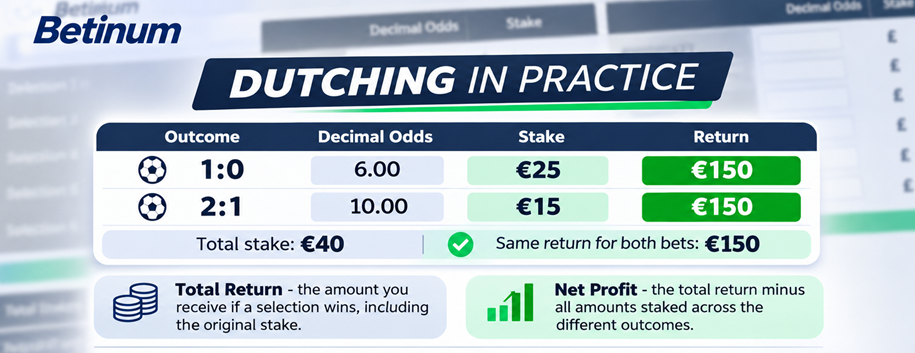
The maths is fairly straightforward. First, divide 1 by the odds of each selection. Add those values together, then use each selection’s share of that total to determine how much of your budget it receives.
This means selections with lower odds get a larger share of your total stake, while those with higher odds receive less.
In our example, the 1-0 selection receives £25, while 2-1 only needs £15. Both bets can return £150 if successful.
It’s important to understand two figures:
- Total payout – the amount you receive from a winning selection, including the stake placed on it.
- Net profit – the total payout minus all the money you’ve staked across your selections.
You can also explore our betting odds calculators to compare implied probabilities, betting odds and bookmaker margins.
When Does Dutching Make Sense?
Dutching is most useful when you’ve analysed a particular market and have solid reasons for including several possible outcomes.
Football Correct Score Betting
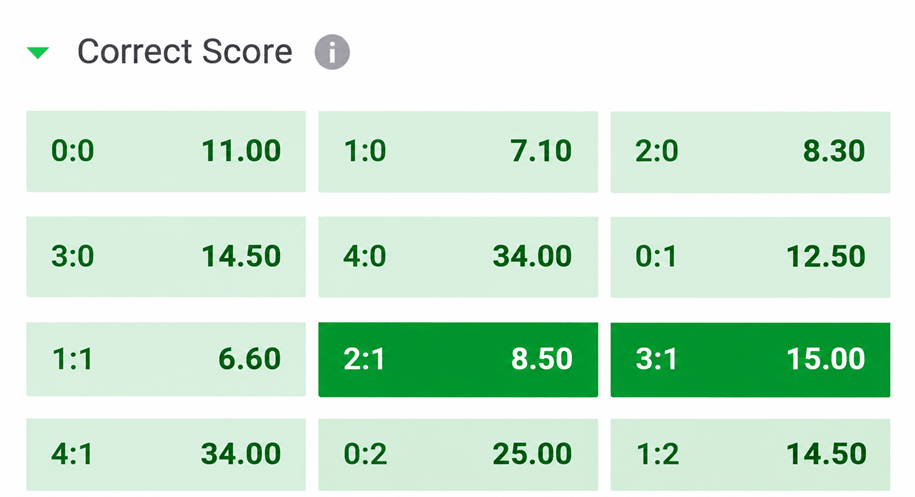
This is one of the easiest ways to understand the strategy.
If you’re expecting a closely matched game with few goals, you might consider results such as 0-0, 1-0 and 1-1. Splitting your stake allows you to cover several scenarios with roughly equal payouts.
Of course, your selections should have a statistical basis. You can use Betinum’s football statistics to examine previous results, goal records and the recent performances of both teams.
Horse Racing
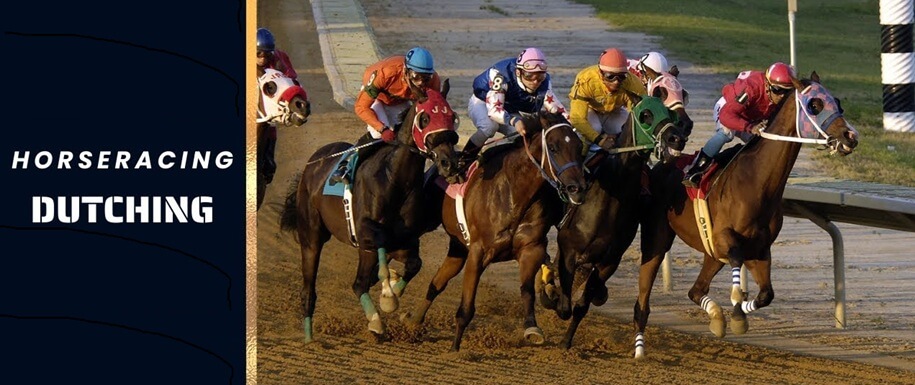
Dutching is also well known in horse racing, where events can have large fields of runners. Instead of choosing a single horse to win, you can spread your stake across several runners you believe have the strongest chances.
The more horses you include, the less potential profit you may have left if one of them wins.
Comparing Odds Across Different Bookmakers

Different bookmakers may offer different odds on exactly the same outcome. Using the best available price for each selection can improve your overall payout.
For example, one bookmaker might offer 6.00 on a 1-0 result, while another offers 6.50. If your probability assessment stays the same, the higher odds represent better value.
Timing also matters here. The odds can change while you’re splitting your stakes between different bookmakers.
Dutching vs Arbitrage vs Matched Betting: What’s the Difference?
All three methods involve placing more than one bet, but they work under different conditions and serve different purposes.
| Method | Main principle | What is the risk? |
|---|---|---|
| Dutching | Distribute your stake across several selected outcomes | You can lose if an uncovered outcome occurs |
| Arbitrage Betting | Cover all possible outcomes when the available odds allow a positive return | Odds changes, betting limits or bets not being accepted |
| Matched Betting | Use bonuses and opposing bets, often through a betting exchange | Hedging errors, commissions and bonus restrictions |
The maths behind arbitrage is similar to dutching. The difference is that arbitrage aims to cover every possible outcome using a combination of sufficiently favourable odds.
If the combined implied probabilities of all possible outcomes add up to less than 100%, the correct stake allocation can produce a positive return regardless of the result, provided every bet is accepted and settled as expected.
Matched betting usually involves using free bets and placing opposing bets on a betting exchange. Dutching can sometimes form part of this process when several outcomes need to be covered.
These differences are also explained in Bet Angel’s dutching resources and Smarkets’ guide to matched betting.
Is Dutching a Good Sports Betting Strategy?
Dutching can be a useful way to distribute your stakes when you have good reasons to consider several possible outcomes. It’s particularly convenient in markets with higher odds, where you want to control how much you’ll receive if one of your chosen selections wins.
Personally, I’d only use this approach after checking the total amount staked, the potential payout and the probability of an uncovered outcome occurring.
Covering more outcomes gives you a greater chance of picking one of the winners, but your financial result still depends on the odds and the actual probabilities. If your chosen combination doesn’t offer sufficient expected value, adding more selections won’t solve that problem.
As with any sports betting strategy, it’s important to decide in advance how much you can afford to lose. Even a carefully calculated stake distribution cannot guarantee a profit.
If we missed something, add it in the comments