
Does the Martingale Strategy Work for Making Money?

To be profitable in betting markets, a bettor needs two things – an edge over the bookmaker and a disciplined approach to managing bets.
One of the most popular betting systems is Martingale. The idea sounds simple – after a loss, you increase the next stake until one winning bet recovers the previous losses. In practice, however, the risk grows much faster than most people expect.
Let’s make the most important point clear from the start – we do not recommend using the Martingale strategy for sports betting. It does not create an edge over the bookmaker, while a longer losing run forces you to stake increasingly large amounts until either your bankroll or the bookmaker’s limits make the next bet impossible.
What Is the Martingale Strategy?
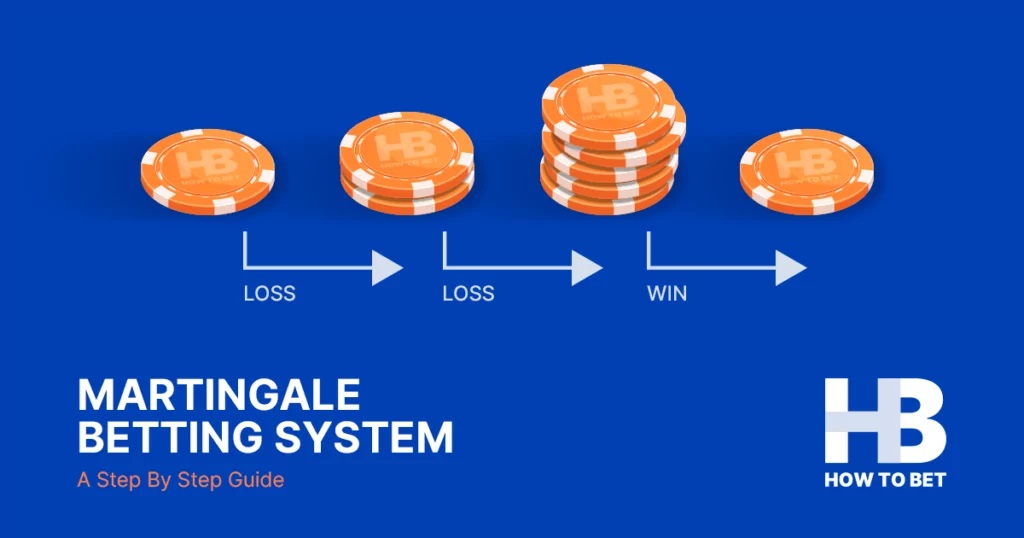
The aim of the strategy is to make a profit roughly equal to the initial stake. With the classic Martingale system, you double the next bet after every loss, so that one winning bet at odds of 2.00 covers the previous losses and leaves you with a profit equal to your starting stake.
If we start with €10, the progression looks like this:
| Bet | Stake | Cumulative loss after another loss |
|---|---|---|
| 1 | €10 | €10 |
| 2 | €20 | €30 |
| 3 | €40 | €70 |
| 4 | €80 | €150 |
| 5 | €160 | €310 |
| 6 | €320 | €630 |
| 7 | €640 | €1,270 |
The main problem becomes clear very quickly. The potential profit from a successful cycle remains €10, while after six consecutive losses you have already risked a total of €630. The main problem becomes clear very quickly. The potential profit from a successful cycle remains €10, while after six consecutive losses you have already risked a total of €630. And this is only the beginning.
With a starting stake of €10, the 10th bet in the sequence would already need to be €5,120. If the losing run reaches the 15th bet, the required stake becomes €163,840. In practice, you would hit either your bankroll limit or the bookmaker’s maximum stake long before reaching that point. In theory, Martingale could work if you had an unlimited bankroll and a bookmaker that allowed you to increase your stake indefinitely. In real betting, both your bankroll and the bookmaker’s limits are finite.
And with this simple calculator, you can see what would happen during a long losing streak:
It is also important to understand what the odds actually tell us. Odds of 2.00 imply a probability of 50%, but that does not prove that the true probability of the outcome is exactly 50%. Bookmakers build a margin into their markets, and the bettor’s job is to decide whether the available price accurately reflects the real chance of the outcome.
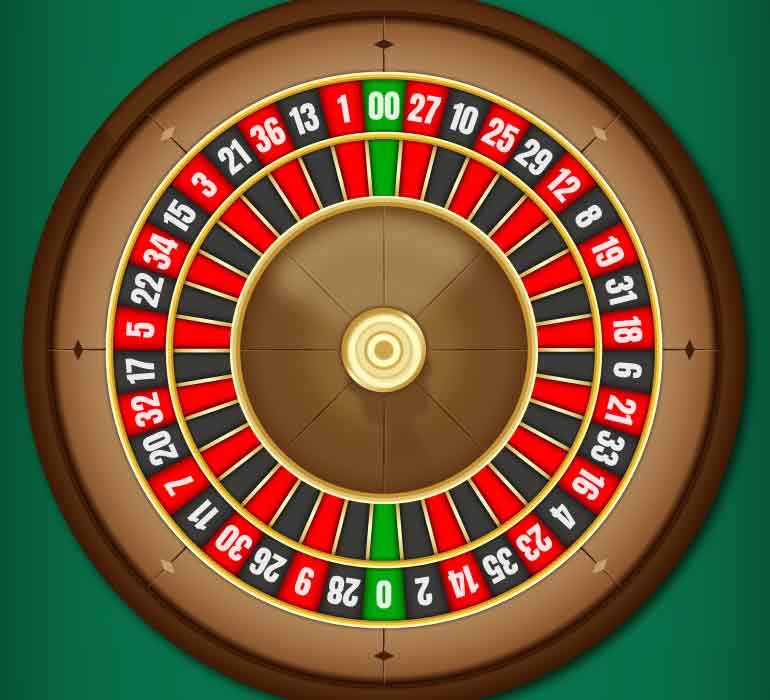
Roulette provides an even clearer example. In addition to red and black numbers, European roulette has a green zero, while American roulette has both 0 and 00. These give the casino its mathematical edge.
How Can a 98% Success Rate Be Misleading?
There is a useful example that explains why Martingale can create the impression that it works almost all the time.
If we assume a genuine 50/50 probability and allow a maximum of six bets in one cycle, the chance of winning at least once within those six attempts is around 98.44%. The probability of losing all six is only about 1.56%.
At first glance, that sounds excellent. With an initial stake of €10, however, a successful cycle produces €10 profit, while six consecutive losses cost €630. One such losing run can wipe out the profit from 63 previous successful cycles.
That is the risk hidden behind the high success rate. You can win small amounts repeatedly and feel as though the system is almost impossible to beat, until one longer losing run sends the result sharply backwards.
Previous outcomes also have no effect on the next independent event. If a roulette wheel lands on red five times in a row, black does not become more likely on the sixth spin.
That is why a 98.44% rate of successful cycles does not mean there is a 98.44% chance that the strategy will be profitable. Martingale can produce many small wins in a row and still allow one losing run to wipe out the entire accumulated profit.
Why Martingale Looks Like It Works – and Why That Is Misleading
Martingale has several characteristics that make it attractive at first. Many cycles end with a small profit, and losing runs may take a long time to reach a critical length, creating a false sense of consistency.
But this is not an edge over the market. The risk is simply concentrated in the rarer but much more expensive losing runs.
Cons
- Betting limits exist. Every bookmaker, betting exchange or broker places limits on the amount it will accept. During a longer losing run, you may reach the maximum permitted stake before you can recover the previous losses.
- You need a very large bankroll. Most bettors would struggle to survive 10-15 consecutive losses while continually doubling the stake. Even if you had enough capital, the potential profit from each cycle would remain small compared with the amount being risked.
- Long losing runs are a real risk. We do not know when they will happen, but the more bets we place, the more opportunities there are to encounter a run that exceeds our predetermined limit.
- The risk does not justify the reward. The target profit remains equal to the original stake, while the amount required doubles after every loss.
- Martingale does not create an edge. If the original bet has negative expected value, changing the stake size does not turn it into a positive-EV bet.
Which Betting Strategy Should You Choose?
Before choosing a staking strategy, I would first recommend learning how betting odds work and then understanding how you can gain an edge over the market.
Martingale answers only one question – how much should you stake after a loss? It does not tell you whether the original bet is good.
There is another problem when using the system for sports betting:
What Happens If the Odds Are Not 2.00?
Classic Martingale doubling works mathematically only at odds of 2.00. In sports betting, we rarely place a sequence of bets at exactly the same price.
Suppose we lose €10 and the next selection is priced at 1.80. If we simply double the stake and bet €20, the profit from that bet is €16. After subtracting the previous €10 loss, we are left with only €6 profit instead of the original target of €10.
To recover the €10 loss and still make another €10 profit at odds of 1.80, the next stake would need to be €25.
At shorter odds, the required progression can become even more aggressive. This makes the classic Martingale approach even harder to apply in real sports betting.
Comparing Different Betting Strategies
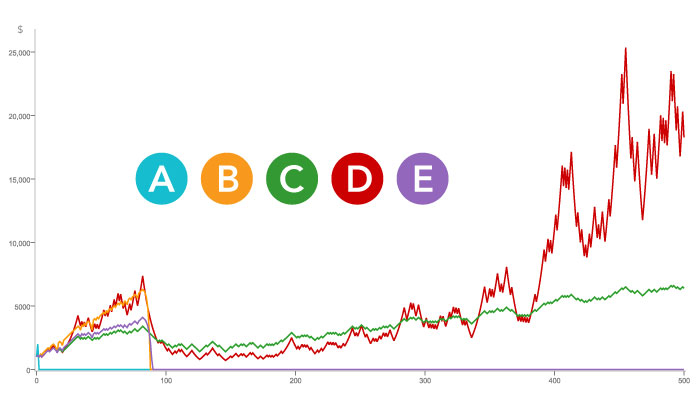
In our simulation, we compare five betting strategies:
- A – All In
- B – Martingale
- C – Flat Stakes
- D – Proportional staking using the Kelly Criterion
- E – Fibonacci
The simulation uses 500 bets, a starting bankroll of $1,000, an initial stake of $100 and an assumed 55% probability of winning each binary bet.
What does the chart show? Martingale may appear stable for a period of time, but once a sufficiently long losing run occurs, the required next stake becomes unaffordable and the bankroll collapses.
| Strategy | How the Stake Is Determined | Main Risk |
|---|---|---|
| All In | Entire available bankroll | One loss ends everything |
| Martingale | Increased after a loss | Stake size grows very quickly |
| Flat Stakes | Same stake every time | Slower bankroll growth |
| Kelly Criterion | Based on bankroll and edge | Incorrect probability estimate |
| Fibonacci | Progression after losses | Risk still increases during a long losing run |
The simulation shows how different the results can be even when every strategy experiences exactly the same sequence of winning and losing bets.
With a $1,000 bankroll and a starting stake of $100, Martingale actually has very little room to operate. After losing $100, $200 and $400, a total of $700 has already been lost. The next required stake is $800, but only $300 remains in the bankroll.
This shows how quickly the system can reach the point where the next required bet simply cannot be placed.
In this particular simulation, proportional staking using the Kelly Criterion (a formula that determines stake size based on your bankroll and estimated edge) produces the best result. With a 55% probability of success and odds of 2.00, full Kelly suggests staking 10% of the current bankroll.
This is a simulation in which we assume that we know the true probability of success – 55%. In real sports betting, that is exactly the difficult part. Nobody knows the precise true probability of an individual bet, and an incorrect estimate of your edge also leads to an incorrect Kelly stake.
For most bettors, the most practical approach is flat staking – using the same predetermined stake regardless of whether the previous bet won or lost. This means a losing run does not automatically force you to increase your risk.
Conclusion
We do not recommend using the Martingale strategy. Risk should come before return because the first priority is to avoid losing your bankroll.
Martingale is attractive because it can produce many successful cycles and a high percentage of winning sequences. That can create a false sense of security. Small profits build slowly, while one sufficiently long losing run can wipe them out in a single cycle.
If the choice is between Martingale and a fixed stake, we would always choose flat staking. First, you need to identify a bet where you believe you have an edge, and then manage your bankroll with discipline. Doubling the stake after a loss does not improve the quality of the original bet.
A system that increases risk after every loss cannot fix a poor betting selection.
If we missed something, add it in the comments