
Does Martingale’s strategy for making money work

To be profitable in the betting markets, the gambler needs two things – an advantage over the bookmaker and a well-disciplined method of betting.
1. What is the Martingale strategy
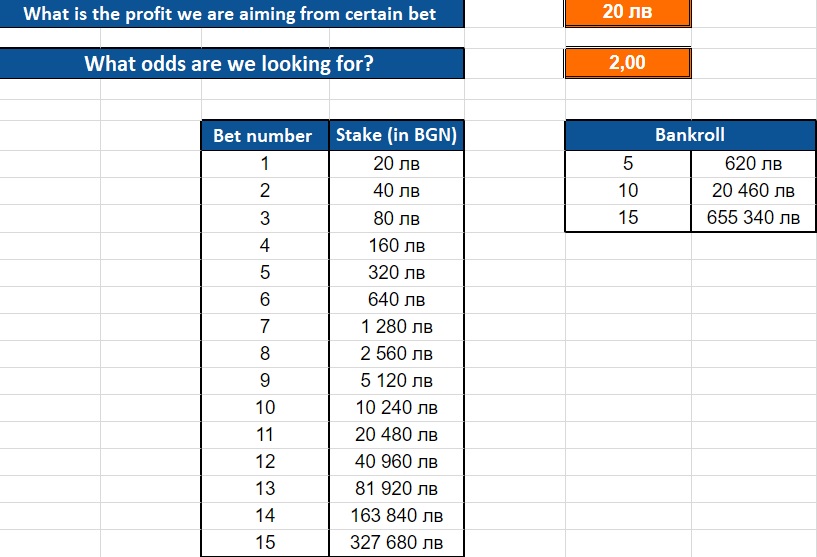
The goal of the strategy is to win an amount approximately equal to the initial bet. For this purpose, the bet is doubled for each subsequent loss in order to kill the previous losses and win an amount equal to the original bet.
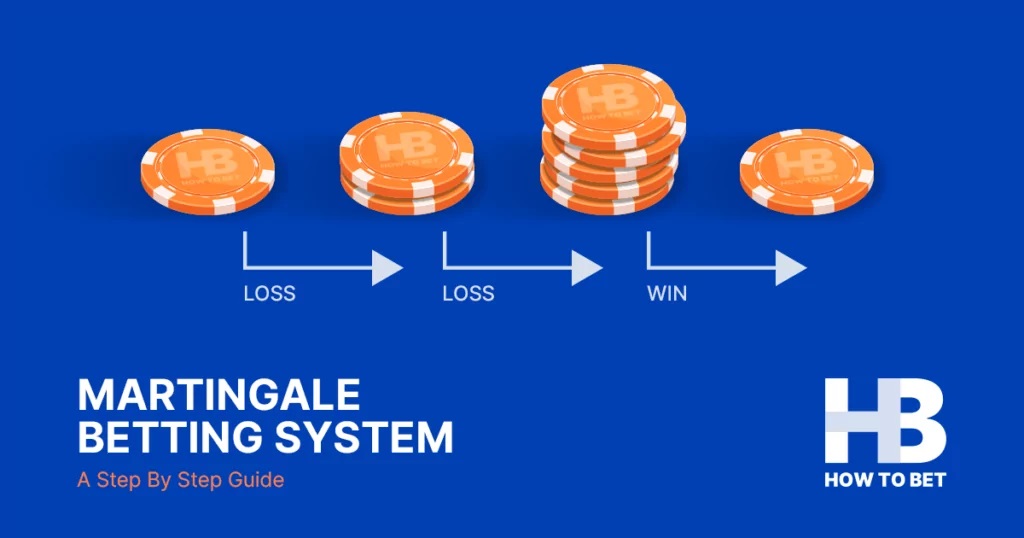
The strategy can only be successful in the long run if someone has infinite wealth and a bookmaker who has no limit on the maximum amount they can bet.
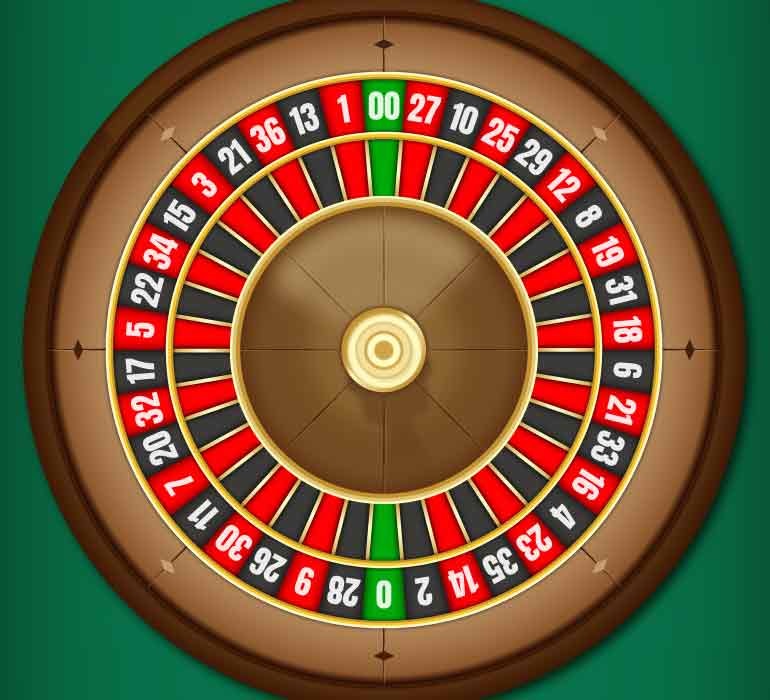
Taking a odds of 2.00, many of you certainly think that’s a 50% chance, but that’s not the case at all. Behind each odds is a margin that collects the bookmaker, i.e. this real odds behind 2.00 is often 2.15, which is equal to 47% approximate chance. You never have a 50% chance. In the casino, there are not only red and black but there is also green, in some casinos – two green.
As you can see on the Martingale Wikipedia page, the probability of a series of consecutive losses is much higher than usual intuition suggests.
There you will also find many interesting Intuitive and Mathematical analyzes of the strategy, which confirm the statement that it is very risky and bad in the long run.
However, there is a good example that shows that there is about a 97-98% chance of winning the amount of the initial bet, which again means that with 100 bets made on average 2-3 times it is possible to lose everything.
The interesting thing about using Martingale is that most people think that previous results have something to do with the current one, but this is not the case. If you play roulette and it turns red 5 times, this in no way guarantees or increases the chance that the next spin will be black.
2. Pros and Cons of the Martingale Strategy
Cons
- Each house (a bookmaker, stock exchange, or broker) has limits on the amounts they accept as bets, i.e. it is not possible to deal with a major bad series;
- It is unlikely that your bank will be able to cover 10-15 consecutive losing bets using this strategy because you are doubling, and even if it can, then the number of your winnings from Martingale will be negligible compared to if you use other betting strategies;
- Bad series is 100% sure in the long run;
- Possibility for limitation by the bookmaker;
- The risk does not justify the reward;
- The chance of doubling your money according to calculations is about 36%, which is a very small percentage.
Pros
- In the short term, it may be profitable;
- You can set a limit of 3 Martingale bets and then stop, for example, without fourths. If each of the bets has an expected value most of the time you will succeed and win the initial amount.
3. Which strategy to choose
To this end, I advise you to first learn what the odds are from our other articles and then how you can gain an advantage over the market.
Guys, now I will show you a simulation that compares 5 betting strategies.
The graph shows the winnings from 500 simulated bets on the 5 systems with a probability of winning of 55% in the case of a binary bet. The total pot of each of the systems is $ 1,000, with the initial bet being $ 100 and the simulation continuing until the 500th bet.
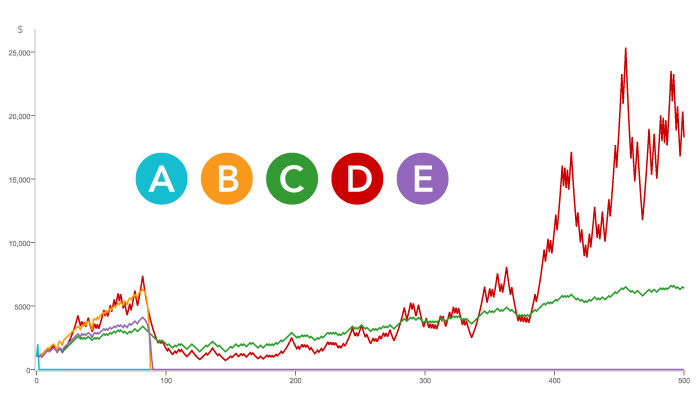
The strategies used in the simulation are:
A: All In
B: Martingale
C: Fixed bets
D: Proportional bets used, using Kelly’s Criterion
E: Fibonacci
We will leave a more detailed review of the simulation for another article and in this one, I will only touch on some conclusions.
The simulation shows that different betting techniques have significantly different results, even if the other variables remain the same. The difference between going bankrupt and ending up with $ 18,000 in winnings after 500 bets is due to choosing the right betting strategy.
As you may have noticed, Martingale’s strategy turned to 83 bets because the simulation made 11 consecutive losses and a $ 403,000 bet was needed to cover the losses.
In the simulation, proportional betting is best represented by Kelly’s Criterion, which means that you bet as much as your advantage is. In the case of the simulation, as I said at the beginning, assuming that each bet has a 55% chance of success, the advantage is 10%, divided by the odds it turns out that each bet must be placed 10% of the bank, but the bank varies constantly, which means that when the bank rises, we bet bigger amounts and grow faster, while when the bank falls, we bet smaller amounts and the bank shrinks more slowly.
4. Conclusion
We look at risk first, then return, because we don’t want to lose our money.
If we missed something, add it in the comments